

What is the GI Bill®?

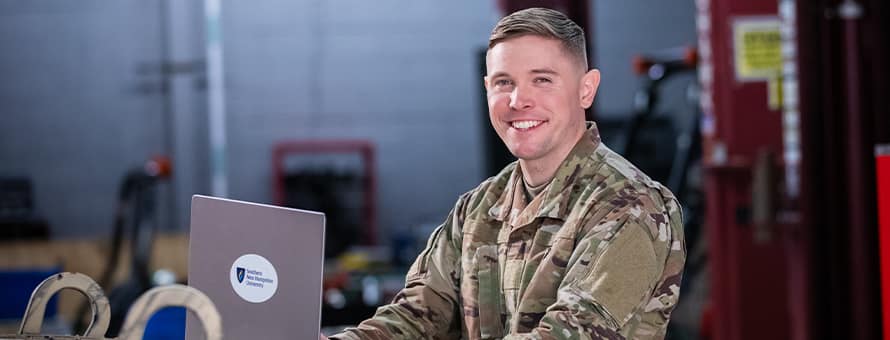
Rob Thomas '24, SNHU graduate and U.S. Army Reserve trainer coach
In the United States, military-affiliations can entitle you to certain educational benefits — in part thanks to the GI Bill®.* While it might sound like that term refers to a single piece of legislation, there's a bit more to it.
“The GI Bill® is a Department of Veterans Affairs (VA) program that provides education benefits to eligible service members, veterans and their families to help pay for education and training programs,” said Joseph Melim, a director of military education benefits at Southern New Hampshire University (SNHU) who has worked at the university for over a decade.
In 2012, the VA opted to officially trademark the term “GI Bill®” in an effort to curb misleading and deceptive promotions targeting those with military affiliations, a VA press release notes.
Melim — a veteran of the U.S. Army, himself — explained the basics of the GI Bill® and answered some important questions you might have.
What is the Purpose of the GI Bill®?
In the midst of World War II, U.S. President Franklin D. Roosevelt signed the Servicemen’s Readjustment Act to prevent a postwar depression, the U.S. National Archives and Records Administration (NARA) reported. The goal was to counter an impending wave of unemployment by providing education and training assistance to help service members enter the workforce as civilians.

The Servicemen’s Readjustment Act was originally dubbed the “GI Bill(®) of rights” by American Legion publicist Jack Cejnar, NARA said, and the name “GI Bill®” stuck.
“First passed in 1944, these federal education benefits were created to help veterans transition from military to civilian life and are administered by the U.S. Department of Veterans Affairs (VA),” Melim said. “Over time, the law has been updated to meet the needs of different generations of America’s veterans.”
Today, he said benefits can also be used by family of service members in some circumstances.
What Does the GI Bill® Cover?
The specifics will depend on a few factors, but the VA reported that your GI Bill® benefits could cover:
- A certain amount of your college tuition and fees
- A monthly stipend for housing
- Supplemental funds for books and supplies
You'll need to determine which programs you're eligible for to find out more. There are 4 major parts of the GI Bill®, according to Melim, with each part entitling assistance to a different eligible group:
 Post-9/11 GI Bill®
The Post-9/11 GI Bill® is also known as Chapter 33, Melim said. This bill offers up to 36 months of benefits, though Melim noted 48 months could be possible in some circumstances.
“(The Post-9/11 GI Bill®) is available to service members who have served at least 90 days of aggregate active duty — full time in the armed forces — after September 10, 2001, or who served at least 30 continuous days and were discharged for a service-connected disability,” he said.
 Montgomery GI Bill® Active Duty (MGIB-AD)
This bill is also called Chapter 30, Melim said. He noted that it’s available to active-duty service members with a certain amount of tenure, offering up to 36 months of benefits.
 Montgomery GI Bill® Selected Reserve (MGIB-SR)
The MGIB-SR is also known as Chapter 1606, Melim said, and it provides 36 months of assistance, too.
“It is a benefit available to service members of the Selected Reserve and National Guard who regularly train but are not considered active duty unless issued orders,” he said.
 Benefit Transfer or Transfer of Entitlement (TOE)
According to Melim, this benefit allows eligible service members to transfer unused Post-9/11 GI Bill® benefits to a spouse or dependent child.
“It has specific service requirements and must be approved by the (U.S. Department of War),” he said.
Does the GI Bill® Expire?
The GI Bill® itself doesn’t expire, but the benefits that it offers you can, Melim said. It all depends on your circumstances and the specific part of the program you’re using.
- Post-9/11 GI Bill®: If you’re trying to determine if your Post-9/11 GI Bill® entitlements have an expiration date, that hinges on whether your service ended before or after January 1, 2013.
“If active-duty service ended before January 1, 2013, the benefits will expire 15 years after the last separation date from active service,” Melim said. “All benefits must be used by that time, or they’re lost.”
For those whose service ended on or after that date, there isn’t an expiration date, according to Melim.
“If active-duty service ended on or after January 1, 2013, benefits won’t expire thanks to a law called the Forever GI Bill® — Harry W. Colmery Veterans Educational Assistance Act,” he said.
- Montgomery GI Bill® (MGIB): MGIB benefits typically expire 10 years after you separate from the military, Melim said. But the same isn’t true if you’re a member of the reserves using the MGIB-SR.
“(MGIB-SR) benefits are available until the eligibility period ends or when all available entitlement is used, whichever comes first,” said Melim.
Connect with the military benefits team at the school you plan to attend for more information about how to use your benefits at that school. You can contact the VA about your available benefits and if they expire at 888-442-4551 or visit the VA website for more information about eligibility.
You can also apply online on the VA's website to use your benefits.
Other Frequently Asked Questions About the GI Bill®
Thinking about using your GI Bill® benefits? Here are the answers to a few more questions that might be on your mind.
Are There GPA Requirements to Maintain?
Although there aren’t specific GPA requirements to maintain the use of GI Bill® benefits, Melim said, the VA requires that universities enforce standards of progress.
“As a result, we are required to report to the VA when a student ceases to make satisfactory progress toward completion of his or her training objective, which includes academic suspensions and academic dismissals, which may have impacts to GI Bill® benefits,” he said.
To stay in good academic standing and protect yourself from any potential impacts, you’ll generally need to keep your GPA above a 2.0 in an undergraduate program, Inside Higher Ed reported.
Can You Use Both FAFSA and the GI Bill®?
You certainly can, Melim said.
“Title IV funding through Federal Financial Aid programs made available through the submission of the FAFSA can be used in conjunction with the GI Bill®,” he said. “Additionally, the VA requires schools to maintain policies that inform an enrolled covered individual of the availability of federal financial aid outside of VA benefits.”
What Other Military Benefits Are Available?
Depending on your military affiliations, Melim said you might have access to benefits beyond the GI Bill®.
Some of these additional benefits could include:
- Dependents’ Educational Assistance (DEA): Also known as Chapter 35, Melim said DEA offers educational assistance to a spouse or child of a veteran who has died, is missing or has acquired a permanent disability through service.
- Edith Nourse Rogers Science Technology Engineering Math (STEM) STEM Scholarship: This scholarship allows eligible veterans using the Post-9/11 GI Bill® or dependents using the Fry Scholarship to get added benefits, Melim noted.
- Marine Gunnery Sergeant John David Fry Scholarship (Fry Scholarship): This scholarship is offered to a child or spouse of a service member or members of the Selected Reserve who died on or after September 11, 2001, Melim said.
- Veteran Readiness & Employment (VR&E): VR&E is also known as Chapter 31, Melim said. “Chapter 31 provides counseling and employment options but can also provide education or training needs for veterans and active-duty service members that have service-connected disabilities,” he said.
- Yellow Ribbon Program: Melim said this program is a part of the Post-9/11 GI Bill® that helps cover tuition and fees at private, out-of-state or graduate schools that the GI Bill® doesn't fully cover. “Due to SNHU’s low tuition, not many students qualify,” he said.
You could have other resources available to you, too, depending on which branch of the military you’re affiliated with, according to Melim.
“Each service branch (Army, Navy, Air Force, Space Force, Marine Corps, Coast Guard) has its own criteria for eligibility, obligated service, application process and restrictions,” he said.

Should You Use Your GI Bill® Benefits?
If you have GI Bill® benefits available to you, putting them to use could help you reach your educational and career goals with a much smaller financial investment. Just ask Ken Girken ’17 ‘21G, who earned an IT-focused bachelor’s degree and a master’s in cybersecurity from SNHU.

Girken initially set out to get a background that could help him grow into a leader in his field. While enrolled, he was able to lean on SNHU’s dedicated student support teams, from personalized advising services to 24/7 academic assistance.
“I'm a veteran and used my GI Bill® through most of my BS (Bachelor of Science) degree and student loans through my MS (Master of Science) degree,” he said. “I found SNHU to be very affordable and the support given to the students is amazing.”
Girken shared that his path led to a position as director of IT and security, which had been his goal. “I feel that my degrees played a big part in not only preparing me for this new role but also providing me with the educational requirements for the job as well,” he said.
You could also use your GI Bill® entitlements alongside other resources to help make your educational pursuits even more affordable. Some schools might offer full-tuition scholarships to a certain number of military-affiliated learners or provide other forms of assistance.
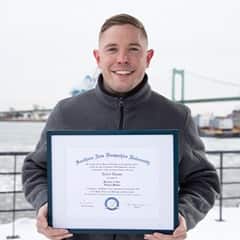
Rob Thomas ’24 earned his degree in general studies from SNHU while serving as an observer coach trainer for the U.S. Army Reserves and opted to take advantage of multiple military benefits and discounts that were available to him.
The flexibility of SNHU’s online programs allowed Thomas to earn his degree at his own pace while balancing his military obligations.
“At SNHU, I used the GI Bill®,” he said. “I was able to earn credit for my military training, which helped me earn my degree faster.” Students can transfer up to 90 credits of prior college coursework towards a bachelor’s degree at SNHU, plus earn credit for Professional Military Education (PME) and on-the-job training (OJT).
In addition to getting assistance from the VA and earning college credits from his military experience, Thomas said that he qualified for SNHU’s military discounts and used them to help with the cost of his degree, too. He said SNHU offered support every step of the way.
“The application process for the GI Bill® is a very easy application process, and the support of SNHU made it even better,” he said.
A degree can change your life. Choose your program from 200+ SNHU degrees that can take you where you want to go. For more information about the military and veteran student experience, visit snhu.edu/military.
*GI Bill® is a registered trademark of the U.S. Department of Veterans Affairs (VA). More information about education benefits offered by the VA is available at the official U.S. government website.
Mars Girolimon '21 '23G is a staff writer at Southern New Hampshire University where they earned their bachelor’s and master’s, both in English and creative writing. In addition to their work in higher education, Girolimon’s short fiction is published in the North American Review, So It Goes by The Kurt Vonnegut Museum & Library, X-R-A-Y and more. Connect with them on LinkedIn.
Explore more content like this article

Fort Campbell’s First Combined Colleges Ceremony Honors 17 SNHU Grads

Meet the Military Spouses Who Just Won Full-Tuition SNHU Scholarships

SNHU Military Grads Honored in Graduation Ceremony at Marine Corps Base
About Southern New Hampshire University

SNHU is a nonprofit, accredited university with a mission to make high-quality education more accessible and affordable for everyone.
Founded in 1932, and online since 1995, we’ve helped countless students reach their goals with flexible, career-focused programs. Our 300-acre campus in Manchester, NH is home to over 3,000 students, and we serve over 135,000 students online. Visit our about SNHU page to learn more about our mission, accreditations, leadership team, national recognitions and awards.