

MFA Director Benjamin Nugent
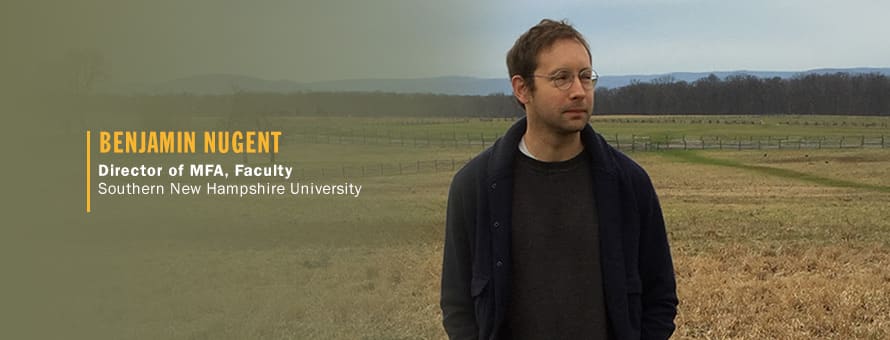
Benjamin Nugent is the critically acclaimed author of "Good Kids" and "American Nerd." His work has been widely published and is included in "The Unprofessionals: New American Writing from the Paris Review" (2015) and "Best American Short Stories 2014."
"Good Kids" (2013), described by many as a romantic comedy, has received praise from The Boston Globe, Harper's, USA Today and his peers. "American Nerd" (2008) earned many accolades from notable publications, including Publishers Weekly, Booklist, GQ, Scientific American, and Time.com.
Nugent is the director of the Low-Residency MFA in Fiction and Nonfiction Program at Southern New Hampshire University.
Have you always written?
I started writing stories when I was five. But when I was a kid I wanted to be a prosecutor, not a writer. Both professions are about building a case, now that I think about it.
What's your process in developing your storyline and characters?
I start with character. Once I get a character to walk around on her own and think independently of me and do whatever she wants to do without me trying to wedge her into whatever crap storyline I have contrived for her, the real storyline emerges.
What challenges do you face in your writing, and how do you overcome them?
I worry a lot about how to balance interesting word choices with clear, plain, undistracting prose. In the end, there's nothing to do but to decide which version of a sentence gives me the most pleasure.
What has the road to publication been like for you?
The road to publication has been reasonably smooth. Writing something good is much harder than getting something published. And if you write something good, publication usually takes care of itself. You get into an MFA program, the professors commend you to their agents, one of the agents picks you up and an editor buys your book. The danger is that it will happen too quickly, when you're publishable but not as good as you will be in two or three years. One night I was at an artists' colony and all the novelists sat around at the dining room table and lamented that they'd been published too early.
How do you market your work?
For the most part I let the publishing house figure out how to do that, but I'm eager to help however I can, and I write magazine and newspaper pieces in advance of publication. My feeling about Twitter is that I'll get on it should a publicist ever ask me to get on it. But it's possible that if I started tweeting I'd be more a liability than an aid.
What do you know now that you wish you knew when you first started writing?
I love being the director of an MFA program because part of my job is telling people what I wish I'd been told when I started writing. I often tell them that careerist plotting and fretting is counterproductive. It actually slows the progress of your career because it distracts you from characters and sentences. And it distracts you from reading. I spent a lot of my twenties in a frenzy of careerist ambition and therefore didn't read enough. I wrote all the time, trying to deliver what I thought the world wanted from me. I did better once I was able to calm down and read.
Who are the authors that have inspired you most, and how have they inspired you?
In no particular order:
- David Foster Wallace, by writing "Infinite Jest." I advise my MFA students to soldier through the first 250-275 pages. If you make it beyond that point a religious feeling takes hold.
- Denis Johnson, by writing "Jesus' Son." My guess is no one will ever know how Johnson did it. Maybe least of all Johnson. At any rate it reads like something large and mysterious just kept on picking him up and drop-kicking him around.
- Ottessa Moshfegh, by being the best short story writer my generation has produced so far. I especially love "No Place For Good People," "The Weirdos," "Dancing in the Moonlight" and "Slumming."
If you could you keep just three books in your library, which would you choose and why?
I'd keep "Infinite Jest" because it's served me well in hard times. I'd keep a collection of Chekhov stories, to remind myself what honesty sounds like. And I'd hold on to "Mrs. Dalloway," to remind myself that each of us has a voice with unique cadences and it's usually chirping away unheard inside the skull.
Rebecca LeBoeuf ’18 is a writer at Southern New Hampshire University. Connect with her on LinkedIn.
Explore more content like this article

Creative Writing MA vs. MFA: What's the Difference?
Nelly Bernal Earned Her Degree to Inspire Her Family’s Next Generation

How to Use AI for Graphic Design: Why Thinking Matters More Than Tools
About Southern New Hampshire University

SNHU is a nonprofit, accredited university with a mission to make high-quality education more accessible and affordable for everyone.
Founded in 1932, and online since 1995, we’ve helped countless students reach their goals with flexible, career-focused programs. Our 300-acre campus in Manchester, NH is home to over 3,000 students, and we serve over 135,000 students online. Visit our about SNHU page to learn more about our mission, accreditations, leadership team, national recognitions and awards.