

Creative Writing MA vs. MFA: What's the Difference?


Understanding the numbers
When reviewing job growth and salary information, it’s important to remember that actual numbers can vary due to many different factors—like years of experience in the role, industry of employment, geographic location, worker skill and economic conditions. Cited projections are based on Bureau of Labor Statistics data, not on SNHU graduate outcomes, and do not guarantee actual salary or job growth.
If you’re the kind of person who loves the nuances of the English language, you know how the omission or addition of a single word can change the meaning of a phrase. As you’re weighing which creative writing programs you want to apply to, your decision may come down to the difference of one word: Do you want to earn a Master of Arts (MA) or a Master of Fine Arts (MFA)?
At first glance, these two creative writing degree paths may seem similar, but each provides a different focus of study and different opportunities for building your career. The specifics of what you want to learn, the skills you want to develop and your expectations for the future are all factors worth considering as you decide which is the right fit.
Is an MFA the Same as an MA?
An MFA and an MA in creative writing are not the same. The two programs do share some common ground, though. Both are writing-intensive, they often include peer workshops and both teach the craft of writing.
However, they differ in several ways:
| MFA | MA |
|---|---|
|
|

What is an MA?
A Master of Arts in Creative Writing is a postgraduate degree that demonstrates mastery of the craft.
Academically, an MA program includes courses in creative writing as well as in literature, literary theory and linguistics. So, along with learning the craft of storytelling, you'll have the opportunity to develop your analytical skills while you study the various lenses through which you can view a work of literature. You'll also study how sentences are structured and how words in the English language have changed over time. Some programs, like SNHU's, also offer elective options in editing, publishing and teaching.
Many MA programs also offer flexibility through concentrations, so students can focus their writing on the form that most appeals to them or best aligns with their career goals. At SNHU, for example, there are several concentration options.

"The MA allows students to take concentrations in fiction, nonfiction, poetry and screenwriting," said Jacob Powers, an associate dean overseeing the bachelor’s and master’s creative writing programs at SNHU, whose writing has been published in Narrative and Out of Stock magazines. "Students can also choose a non-concentrated route, where they take courses in multiple genres."
The combination of varying coursework and concentration options makes an MA a fit for a wide range of writers. "It's a good choice for those who want a deep understanding of creative writing and its place in the literary and academic world, while also preparing for a variety of potential career paths — whether in teaching, publishing or other creative industries," Powers said.
After earning an MA, some graduates may choose to continue their education in an MFA program or by earning a PhD in literature, for example.
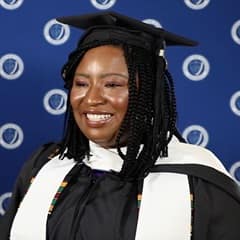
Adanze Chukwuocha ‘23G said she earned her bachelor’s in a subject that she wasn’t very passionate about. "I was very upset," she said. "I wasn’t doing what I loved. I wasn’t the person who I thought I was going to be."
So she went back to school, earning her master’s degree in English and creative writing at SNHU. "With the experience I’ve gained, I’m just a better person, and I'm very, very thankful for that," she said. "I want to write professionally. I want to perform. There are a lot of things I want to do, and I think this degree is a great next step on my journey."
Her program also gave her the push she needed to complete a writing project. "I finished a story that I worked on for years and years, and I finally got the support from my professors, my classmates," she said.
Learn more about what you can do with a master's in English.
What is an MFA?
Like an MA, a Master of Fine Arts in Creative Writing is a postgraduate degree that demonstrates mastery of the craft. An MFA, however, is a terminal degree — the highest level of education you can earn in the field.
Unlike an MA, MFA coursework focuses more intensively on writing practice rather than additional study in literature and theory. By the end of your MFA program, you should have a completed, full-length manuscript for your MFA thesis.
In addition to intensive writing practice, some MFA programs, like SNHU's, also include publishing courses so you can learn the business side of writing. At SNHU, that also includes courses where you'll learn how to leverage social media and build your author platform online.
MFA programs may also offer concentrations. At SNHU, for example, the online MFA focuses on fiction writing but allows students to specialize in genre fiction.
"We offer students the ability to write and study in four genres: contemporary, romance, YA and speculative," said Paul Witcover, an associate dean overseeing the online MFA program at SNHU and celebrated author of several novels, including "The Emperor of All Things," its sequel "The Watchman of Eternity," and "Lincolnstein."
An MFA is generally a good fit for writers who want to hone their craft with the purpose of becoming a professional writer, novelist or full-time professor. Witcover said the degree can also carry practical upsides in the field.
"An MFA can confer some additional prestige because it is a terminal degree," he said. "It may give writers an advantage in submitting to agents and publishers, as well as applying for grants and writing positions generally."
The Different MFA Programs
While an MA in creative writing follows the traditional in-person and online avenues for earning your degree, there are three ways to earn your MFA.
- Full-residency. As a full-resident MFA student, you'll be going to school full-time on a campus. In full-residency programs, you may have the opportunity to become a teaching assistant and help instruct an undergraduate creative writing course.
- Low-residency. In a low-residency MFA, you’ll spend a period of time each year in residence with faculty and students, while working from home for the rest of the time. For example, SNHU’s Mountainview MFA program requires two weeks in-residence twice a year, and remote work for the remainder of the time.
- Online. With some programs, you have the opportunity to earn your MFA entirely online. The expectations are the same, but you're able to continue working full-time if necessary while you complete your degree.
Keep reading: What is an MFA degree?
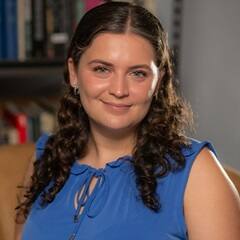
When Jessica L. Cozzi '22G graduated with her bachelor's degree in 2020, she knew she eventually wanted to pursue an MFA. First, she wanted to get her foot in the door of the publishing industry.
And she did. Cozzi started as an editorial assistant and now works as a publicist for HarperCollins in New York City.
But balancing work, her two-hour commute and the idea of an in-person MFA program was daunting. When she discovered SNHU's online MFA with no residency requirements, she knew it was the right program for her.
"I just thought it was really, really amazing, because the fact that it was asynchronous meant that I was able to do schoolwork on the weekends and on evenings after work," she said. "I didn't want to have to choose between grad school and my dream job."
Now, Cozzi is a published author. Her debut YA romance, "We've Hit Turbulence," was published in January 2026 from Delacorte Romance, an imprint of Penguin Random House. Her next novel, "The Rom-Com Conundrum," is set for release in Fall 2027.

Can You Earn an MA or MFA Online?
Yes, you can earn an MA or MFA online.
At SNHU, the online options are especially well-suited for students balancing busy lives and other responsibilities. "Both programs are designed to be rigorous yet asynchronously flexible," Powers said.
For the MFA specifically, Witcover noted that the online format opens the door for writers who might not otherwise have access. "We pride ourselves on putting the MFA degree within reach of anyone who has dreamed of pursuing their writing ambitions but was prevented from doing so by family or work obligations," he said.
And while the act of writing itself is a solitary activity that lends itself well to an online learning environment, Witcover said online doesn't mean students are isolated. "Rather, graduate students in creative writing at SNHU are part of a rich and robust community of writers," he said.
During classes, according to Powers, both programs have students participate in workshops to learn to give feedback and support to their peers.
Outside the classroom, SNHU’s MA and MFA programs also offer regular extracurricular activities for students who want to engage with the broader writing community. These include:
- Word for Word: a recurring webinar that hosts award-winning, best-selling writers and publishing professionals to talk about their work and writing journeys. They also engage with audience questions.
- Wireside Chats: a monthly webinar hosted by Witcover, featuring SNHU faculty, alumni and students in an informal chat with varying topics.
- The Penmen Review: an online literary journal where writers can submit their work for publication, including weekly selections and contests like the Fall Fiction contest.
- Annual pitch sessions: held twice yearly, where MA and MFA graduates can pitch their work to real, working literary agents.
- SNHUconnect's Creative Writing Club: a virtual space for creative writers of all levels to connect, share their work and participate in a student writing community.
Read more about how to get involved as an online student.
Is an MFA Better Than an MA?
Not necessarily, said both Powers and Witcover. "I wouldn't compare the value of the programs directly because they serve different needs," Powers said.
Those needs include your goals, your writing focus, your time commitment and where you want your degree to take you career-wise.
According to Powers and Witcover, a few factors you might consider when choosing a path are:
| An online MFA at SNHU may be right for you if: | An online MA at SNHU may be right for you if: |
|---|---|
|
|
Of course, these are just a few factors to consider, and it's worth noting that experience can also play a role in your potential opportunities. For example, Witcover said that many of his colleagues who teach in MFA programs, including himself, hold only a master's degree. But because they have published works, they are qualified to teach at the college level. "A strong publication record in traditional publishing will trump anything," he said.
What Jobs Can You Get With an MA or an MFA in Creative Writing?
There are myriad career paths available to MA and MFA degree holders, largely because of the skills you'll develop along the way. For example, creative writers are experts at crafting a narrative. They know how to communicate, think critically and condense complex information into clear, accessible language for different audiences. They also know how to edit, collaborate and research.
These skills are transferable across a variety of industries, including public relations, content creation, consulting, publishing and even human resources. “The possibilities are many,” said Witcover.
Here are just a few examples of careers in creative writing:
 Writers And Authors
There are a host of potential career options for a writer and author, allowing you to do what you love. These could include:
- Copywriter
- Digital content creator
- Journalist
- Novelist
- Scriptwriter
The day-to-day duties, salary and benefits of a creative writer vary widely and often depend on what type of writer you are.
- Median salary: $72,270 per year, The Bureau of Labor Statistics (BLS) reports*
- Projected growth rate through 2034: 4%, BLS reports*
 Technical Writer
Use your editing abilities to ensure manuals and other content are clear and concise. If you’re hyper-focused on consistency and structure, being a technical writer is a career you can consider.
- Median salary: $91,670 per year, BLS reports*
- Projected growth rate through 2034: 1%, BLS reports*
 Advertising, Promotions And Marketing Managers
Creative writing skills are an essential part to the marketing sector. Finding the right words to sell a product is an art, as is the copyediting required to ensure no mistakes are made in the final advertisement.
- Median salary: $159,660 per year, BLS reports*
- Projected growth rate through 2034: 6%, BLS reports*
 Public Relations Specialists
Writing speeches, drafting press releases and responding to the media on behalf of your client put your creative writing skills to the test.
- Median salary: $69,780 per year, BLS reports*
- Projected growth rate through 2034: 5%, BLS reports*
 Post-Secondary Teachers
If you want to help mold the next generation of writers, consider becoming a creative writing teacher at a college or university.
- Median salary: $83,980 per year, BLS reports*
- Projected growth rate through 2034: 7%, BLS reports*
While there are differences between an MA and an MFA, both offer opportunities for you to grow as a writer. Ultimately, the choice between the two programs comes down to you – your writing goals, your commitments and your desired future path.
Discover more about SNHU's online master's in English and creative writing or MFA in creative writing: Find out what courses you'll take, skills you'll learn and how to request information about the program.
*Cited job growth projections may not reflect local and/or short-term economic or job conditions and do not guarantee actual job growth. Actual salaries and/or earning potential may be the result of a combination of factors including, but not limited to: years of experience, industry of employment, geographic location, and worker skill.
Rebecca Cahill '26 is a content marketing assistant and writer at Southern New Hampshire University (SNHU). She completed her bachelor’s in creative writing and English at SNHU and is now pursuing a master's in English and creative writing. Based in Ohio, she has also written for FreshWater Cleveland and The Land and serves on the board of Literary Cleveland. When she’s not writing, you'll most likely find her nose in a book, dogs at her side, surrounded by way too many houseplants. Connect with her on LinkedIn.
Explore more content like this article

Why the Humanities Are Important Now More Than Ever

Academic Spotlight: Dr. Karen Wilkinson, Associate Dean of Online Communication Programs
Nelly Bernal Earned Her Degree to Inspire Her Family’s Next Generation
About Southern New Hampshire University

SNHU is a nonprofit, accredited university with a mission to make high-quality education more accessible and affordable for everyone.
Founded in 1932, and online since 1995, we’ve helped countless students reach their goals with flexible, career-focused programs. Our 300-acre campus in Manchester, NH is home to over 3,000 students, and we serve over 135,000 students online. Visit our about SNHU page to learn more about our mission, accreditations, leadership team, national recognitions and awards.