

Stages of Game Development: From Concept to Release


One of your favorite studios finally announced the release date of a much-anticipated game. It’s still months away, but now you can clear your calendar, preorder the collector’s edition and count down the days.
The game has probably been in the works for years. But what exactly happened at each stage of game development?
How a Video Game is Made
There are three primary stages of video game development: pre-production, production and release.
Within each stage, though, are many moving parts involving a concerted effort of game art, design and programming skills, according to David Carrigg, an assistant professor of game and simulation programming at Southern New Hampshire University (SNHU). Carrigg has industry experience as a gameplay engineer, indie developer, chief technology officer and technical director.
 Pre-production

As many projects do, video game development starts with a concept — a vision for a playable game. This exploratory stage, Carrigg noted, involves:
- Design teams: Brainstorming story, gameplay interactions and more
- Technical teams: Figuring out the best methods to create those interactions
- Artists: Determining how to convey it all visually
“When a game enters the ‘pre-production’ phase, which is the time where large decisions about how the game will be designed and developed, all of these teams need to work together to chart the path forward,” Carrigg said.
During pre-production, game developers are creating multiple prototypes, according to Brandon Crose, an assistant professor of game design at Southern New Hampshire University (SNHU).
The prototypes are used to test different aspects of the game, including:
- Aesthetics
- Mechanics
- Physical interactions
Creativity is a hallmark of the pre-production stage, but there are business elements to consider as well, noted Max Callahan, an associate dean of game design and development at SNHU. Producers and project managers get involved during this planning portion of pre-production.
“It's really important to be able to plan and scope a game so that it comes in under budget, and that it comes in on time,” said Callahan, who worked as an art director in the film industry before transitioning into animation and game development.
 Production

Those timelines and budget plans keep a game on track once it enters production.
“During the production phase, which can span several or many years, it’s all hands on deck,” said Crose, who is a lifelong gamer, creative professional and tabletop game developer.
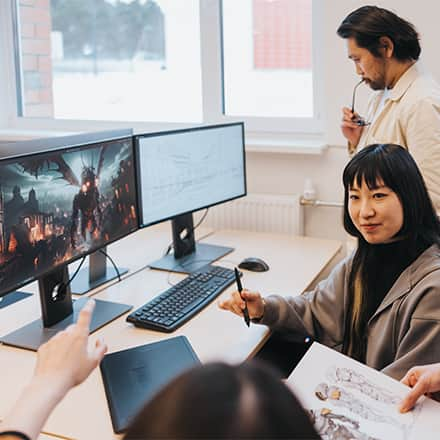
Game designers, programmers and artists are joined by many other roles, he noted, including sound designers, composers and quality assurance (QA) testers.
Inviting playtesters into this stage is also a critical part of the process, so developers can truly understand what the game’s gameplay experience is like.
“Running a playtest is not just about seeing if people liked your game,” Crose said. "It is about discovering what, specifically, they liked about it, as well as what they didn’t like, when they were bored or confused (and why), what they wished they could do but couldn’t, as well as countless other invaluable insights.”
This feedback will inform additional iterations.
 Release
As production on a video game is wrapping up, marketing teams get involved — “to build up to the game’s release,” Crose said. That’s when you’ll start seeing trailers and other types of teasers.
And when a game is finally in your hands, it’s important to note that a game developer’s job isn’t over.
“After release, a small team will likely continue to support the game through patches, expansions or other downloadable content,” Crose said.
Learn on Your Schedule
At SNHU, college can fit your life. And with no set class times and multiple term starts per year, you can apply when you’re ready.
Undergraduate: January 4, 2027
Graduate: December 7, 2026
Find your program
Who is Involved in Each Stage of Creating a Video Game?
Some gaming professionals will see a game through the entire game development pipeline, while others will only be involved during certain parts.
Examples of who is involved at each stage include:
|
Pre-production |
|
|---|---|
|
Production |
|
|
Release |
|
The exact number of people involved depends on the studio size.
“Developing a video game can be a huge undertaking by a large number of people with an incredibly wide range of skills,” Carrigg said. “Although there are many cases where small teams, even as small as a single person, can create truly special and unique games.”
So, in a larger studio, a game developer might be focused on one aspect of game production (e.g. level design), whereas a game developer at a small studio may contribute to a game in a lot of different ways.
Carrigg personally enjoys working on smaller teams of 5-12 developers.
“With a group that size, everyone can still have a lot of input on all aspects of the projects while also having their own specialties,” he said.
If game design interests you, learn more about how to become a video game designer.

How to Get Game Development Pipeline Experience
If you’re interested in becoming a game developer, you might pursue a bachelor’s degree in game design and development. This program will help you build foundations in various aspects of game development — and in a gaming concentration of your choice, like design, programming or art.
At SNHU, online and campus game students will have the opportunity to put all that they learn into action in studio courses that simulate the game development pipeline.

The first studio course, Callahan said, involves forming cross-functional teams to design and plan a prototype and game proposal. In the second course, new teams will form to build playable games based on some of the proposals.
“Students work in teams to conceptualize, design, produce and market original playable games,” Callahan said. “This collaborative process reflects how games are made in the industry.”
Introducing students to the production pipeline and what it’s like to be on a collaborative development team was an experience SNHU prioritized when recently redeveloping its game design and development program, Callahan noted.
“We thought it was really crucial that we give students that experience of working together as a team and — most importantly — to actually build a game, because this is one of those industries where a lot of jobs are looking for candidates to have a published game on their portfolio in order to get a job,” he said.
Ready to Level Up?
Discover more about SNHU’s online game design and development degree: Find out what courses you'll take, skills you’ll learn and how to request information about the program.
Rebecca LeBoeuf Blanchette '18 '22G is a writer at Southern New Hampshire University, where she fulfills her love of learning daily through conversations with professionals across a range of fields. She earned her Bachelor of Arts in Communication with a minor in Professional Writing at SNHU’s campus in Manchester, New Hampshire, and followed her love of storytelling into the online Master of Arts in English and Creative Writing at SNHU. Connect with her on LinkedIn.
Explore more content like this article

How Tim Pressed Start on a Career in Game Development
How to Become a Game Developer

What Do Programmers Do, Anyway?
About Southern New Hampshire University

SNHU is a nonprofit, accredited university with a mission to make high-quality education more accessible and affordable for everyone.
Founded in 1932, and online since 1995, we’ve helped countless students reach their goals with flexible, career-focused programs. Our 300-acre campus in Manchester, NH is home to over 3,000 students, and we serve over 135,000 students online. Visit our about SNHU page to learn more about our mission, accreditations, leadership team, national recognitions and awards.