


Looking to gain professional experience, and market your skills along the way? Do it with HEaRT.
Specially designed for college students, HEaRT (Higher Education and Real-world Training) is a powerful experiential learning opportunity at SNHU. These online, asynchronous, voluntary experiences help connect you with employers to help solve real-world business problems – so you can be ready to make an impact in your field.
Not yet enrolled at SNHU? Reach out today to find out how our degree programs can help you reach your goals.
Why HEaRT at SNHU?
Build skills
Develop technical and soft skills employers look for
Save money
Apply experiences toward course credit and save on tuition
Expand your network
Collaborate with global leaders, peers and faculty
Earn digital badges
Market yourself to future employers

How it works
At SNHU, we're committed to expanding access to education. HEaRT takes that commitment to the next level, giving students a powerful hands-on experience to help them achieve their goals. Watch the video to learn more.
2 Ways To Engage
HEaRT Challenges
We introduced our innovative HEaRT challenges for nursing and healthcare students in 2018, as a way to further close the gap between higher education and employers. Each challenge is 8 weeks long, and students operate in teams to work on projects presented by real employers to gain hands-on, real-world training before they graduate.
HEaRT Solutions Lab
In response to the need for opportunities that are flexible and equitable for all students, we launched the HEaRT Solutions Lab (HSL) in 2021. Like HEaRT challenges, HSL offers experiential learning in a team environment with real-world projects. However, HSL timelines are shorter and there are multiple projects students can choose from twice a year.
Take a look at the side-by-side comparison chart to learn more.
| HEaRT Challenges | HEaRT Solutions Lab (HSL) | |
|---|---|---|
| Who's eligible? | Eligibility is currently on hold | Undergraduate Business, Nursing, Healthcare, Psychology and Human Services Students |
| How long is it? | 8 weeks | 4 weeks |
| When is it offered? | Offerings are currently on hold | Fall and spring |
| Who would guide me? | Guided by mentors | Led by facilitators |
| What course credits can I get? | Get credit for IHP-510, IHP-610 and IHP-630 | Get credit for SNHU-290: Experiential Learning |
| What does the final project look like? | Complete with executive summary and slide presentation | Complete with final deliverable of choice |
Note: Additional eligibility requirements may apply. Contact an admission counselor to learn more.

What Students Are Saying
Julia Oduol
"I have gained a lot of experiences that will benefit me in my professional life, and I will continue to develop them in the future – such as time management, teamwork and critical thinking."
Digital badges
When you complete a HEaRT challenge or HEaRT solutions lab, you earn digital badges you can share on social media or in your online portfolio. And they're not just great for your resume – they can save you money, too.
Here's how it works for HEaRT challenges: Each challenge falls under 1 of 3 content areas. Each content area corresponds to a specific graduate-level course. When you complete all the challenges in a specific content area, you can get course credits for a small fee by applying for credit for prior learning. And because HEaRT is free, that means you can save money on tuition for every course you satisfy.
| Content Area | Corresponding Course |
|---|---|
| Marketing and Communication Strategies | IHP-510: Marketing, Communications Strategies and Outreach |
| Regulations and Policy | IHP-610: Health Policy and Law |
| Reimbursement and Finance | IHP-630: Health Finance and Reimbursement |
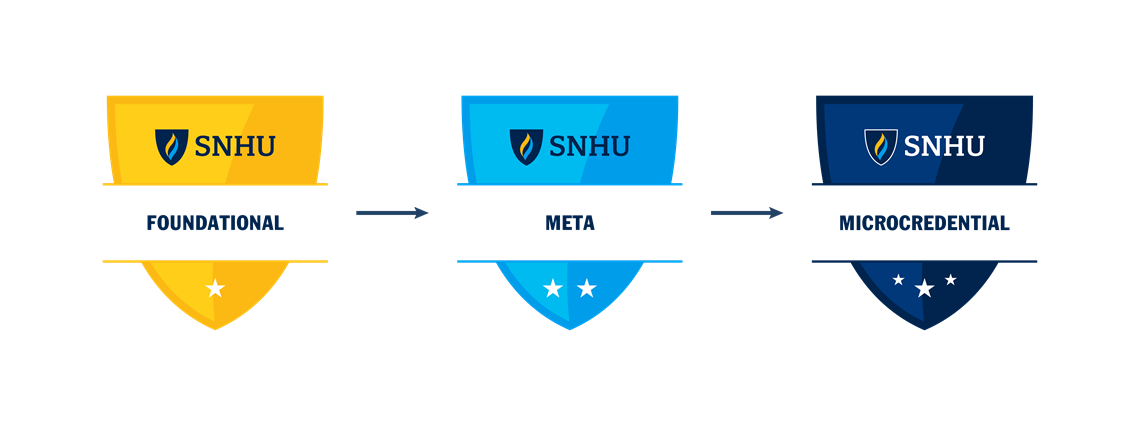
The HEaRT Solutions Lab works a little differently. For each HSL project you complete, you'll earn an experiential learning badge. After you complete 3 badges, you're eligible to obtain undergraduate course credit for SNHU-290: Experiential Learning, for a small fee through the credit for prior learning process.
Here's an example of how the badges you earn can ladder up to course credit:
Awards and recognition
University Professional and Continuing Education Association (UPCEA) New England Excellence in Engagement Award, 2020
A regional award that recognizes an outstanding mutually beneficial exchange of knowledge and resources between a member institution and one or more external constituents such as local communities, corporations, government organizations, or associations.
Online Learning Consortium (OLC) Effective Practice Award, 2020
A national award that recognizes successful efforts that help make quality online education accessible and affordable for anyone, anywhere, at any time, and provide an opportunity for recipients to share effective techniques, strategies, and practices in online education.
Association of Continuing Higher Education (ACHE) Distinguished Program for Non-Credit Award, 2021
A national award that recognizes outstanding contributions to the advancement of continuing higher education.
D2L Excellence Award, 2021
A national award that recognizes educators, trainers, and leaders in employee engagement who have used the Brightspace platform to deliver learning experiences that are innovative, collaborative, or have made an extraordinary impact on learning outcomes.
Highlighted as a Microcredential in Practice in the 2022 EDUCAUSE Horizon Report, Teaching and Learning edition.
WCET Outstanding Work (WOW) Award, 2022
A national award by WCET (leader in the practice, policy, & advocacy of digital learning in higher education) that recognizes outstanding efforts by member institutions and organizations in applying innovative solutions to a challenging educational need.
American Association of Colleges of Nursing - Innovations in Professional Nursing Education Award for Higher Education & Real-World Training Solutions Lab, September 2023
The awards program recognizes the outstanding work of AACN member schools to re-envision traditional models for nursing education and lead programmatic change.
2024 Council for Adult and Experiential Learning (CAEL) - Adult Learner Impact Award for Higher Education & Real-World Training
The CAEL Adult Learner Award spotlights excellence in adult education, recognizing programs that bridge the gap between aspiration and achievement. It celebrates institutions that demonstrate exceptional commitment to making higher education accessible and meaningful for working adults.

What Employer Partners Are Saying
Matt Frederiksen-England – Chief Compliance Officer, University of Missouri Health Care
"A digital badge tells me an individual is engaged. I want employees on my team who are engaged, who are willing to receive feedback, and who have taken steps in their past to go above and beyond."
Frequently Asked Questions
What types of challenges have students worked on?
HEaRT challenges and HSL projects highlight authentic problems organizations face today. Our students have partnered with hospitals, rehabilitation facilities, retirement communities and more to make meaningful changes in their communities.
Some past HEaRT challenges include, but are not limited to:
- Reimbursement. Teams work as consultants to identify access concerns associated with Medicare Advantage plans and post acute care.
- Communications. Teams conduct research on violence against healthcare workers and develop an infographic presenting effective solutions.
- Financial practices. Learners research and present recommendations to improve current admission and transfer processes to reduce expenses and maximize clinicians’ time with patients.
- Marketing. Teams develop a marketing strategy to reach potential teletherapy patients and increase mental health awareness and advocacy.
- Policy. Learners assume the role of healthcare consultants tasked with investigating best practices employed by various healthcare facilities to navigate the complex landscape of regulations and policies pertaining to the adoption of Artificial Intelligence (AI).
- Regulations. Teams identify dress code best practices based on other long-term care facility policies and research, and present policy recommendations based on findings.
Some past HSL projects include but are not limited to:
- Developing health and wellness content for senior living communities
- Bringing awareness to community mental health resources via a social media campaign
- Identifying retention strategies to address healthcare worker burnout
- Investigating the potential benefits and concerns related to incorporating Artificial Intelligence (AI) technologies into retirement communities.
Does HEaRT or HSL cost anything? Will I be billed?
No - as long as you're enrolled in an eligible program, you'll have access to HEaRT at no cost to you.
If you choose to apply your HEaRT experience toward course credit, we do ask for a credit for prior learning (CPL) fee of $100 to complete the process. But even then, when you consider the $1,800 in tuition you'd save per course – and the $5,000 you'd save from satisfying all 3 eligible courses – it's hard to pass up.
What is experiential learning?
Experiential learning is another way to say: "learn by doing." These experiences can be highly valuable, as they provide a gateway for students to gain hands-on, real-world training even before they graduate. They can also be a powerful network and resume builder.
Think about how impressed a future employer will be knowing you have what it takes to make a measurable impact on a business. As a supplement to the knowledge you gain throughout your degree program, these experiences can be a major differentiator.
It's worth noting, too, that HEaRT is just one example of experiential learning at SNHU. In addition to HEaRT, we offer a number of experiential learning opportunities.
What is a digital badge? Why do I need it?
A digital badge is an artifact that showcases your success and demonstrated learning in a chosen area. On platforms like LinkedIn, badges can be added to your profile, and made visible to your entire professional network – including employers and hiring managers.
Digital badges also showcase your commitment to lifelong learning and self-improvement – making you an even more attractive team member for current and future employers.