

How to Use AI for Graphic Design: Why Thinking Matters More Than Tools

Understanding the numbers
When reviewing job growth and salary information, it’s important to remember that actual numbers can vary due to many different factors—like years of experience in the role, industry of employment, geographic location, worker skill and economic conditions. Cited projections are based on Bureau of Labor Statistics data, not on SNHU graduate outcomes, and do not guarantee actual salary or job growth.
Graphic design has always been judged by how effective it is — not whether it looks good or wins awards, but whether it connects, communicates and moves an audience to act.
Artificial intelligence (AI) hasn’t changed that standard. It has made that standard more visible.
Today, anyone can generate a logo or a layout in seconds. What they can’t do as easily is explain why it works, how it fits a brand or whether it will resonate with the people it’s meant to reach.
That is where the role of the designer is shifting. And that’s where the opportunity is.
If you’re studying or working in graphic design right now, you are not behind. You’re entering, or already navigating, a moment when the barrier to getting started is lower than ever, but the opportunity to stand out is higher than it has ever been.
How AI Is Used in Graphic Design

AI is already built into the design workflow.
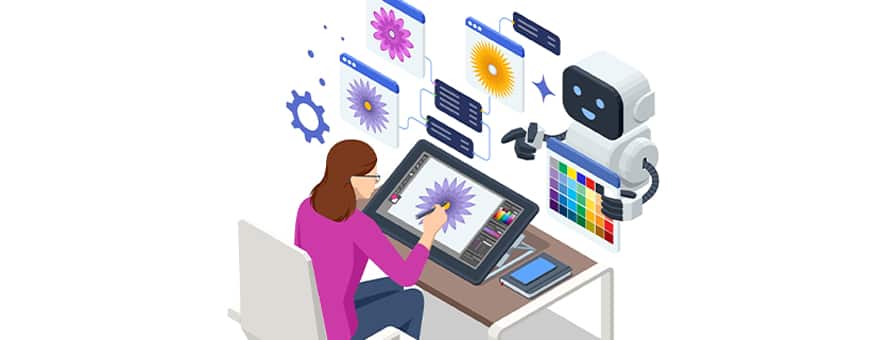
Tools within Adobe Creative Cloud, including Photoshop, Illustrator and InDesign, along with Figma’s AI features, allow designers to generate concept directions, create visual assets and explore multiple variations in a fraction of the time it once took.
AI is also widely used for repetitive production tasks such as resizing, background removal and color palette generation. This frees up time for higher-level thinking and more intentional creative work.
In practice, this often means generating a range of initial concepts with AI and then refining those ideas manually to align with a specific brand or audience.
The real advantage isn't just speed. It’s the ability to explore more creative directions, visual styles and strategic approaches. The quality of the work, however, still depends on the designer.
Can AI Replace Graphic Designers?
It’s one of the most common questions in the field right now, and the short answer is no.
AI can automate parts of the design process, especially tasks that are repetitive or production-based. But it still struggles with complex layout decisions, nuanced typography and translating human intent into meaningful visual outcomes.
What AI cannot replicate is lived experience, perspective and human judgment. Designers bring context, empathy and the ability to interpret what a message needs to do in the real world. That’s what turns a visual into something meaningful.
Higher-level work such as branding, storytelling and campaign strategy remains human-driven. Industry reporting from Harvard Business Review and Fast Company consistently highlights this distinction between automated output and strategic creative work.
According to the U.S. Bureau of Labor Statistics, there are still around 20,000 graphic design job openings each year in the United States.*
The expectations are shifting. But the field is evolving, not disappearing.
Keep Reading: What Jobs Will AI Replace?
What’s the Best AI Use for Graphic Design?

The most valuable use of AI in design is not generating finished work. It’s using AI to think faster and explore more creative directions, visual styles and strategic approaches.
This typically includes:
- Generating rough concepts to react to, not to publish
- Testing color and layout directions before committing
- Automating production tasks that would otherwise take hours
The risk is relying on AI too heavily. Generated work can look polished and still lack originality. It can follow a trend without aligning to a brand. It can look right and communicate nothing.
There are also ongoing questions around copyright and ownership of AI-generated assets, which every working designer should understand.
The goal is to use AI to support your thinking, not replace it. That distinction is what separates designers who create meaningful work from those who simply produce a high volume of it.
Is There a Future for Graphic Designers?
Yes, and in many ways, it’s a more dynamic one than before.
Designers are increasingly expected to contribute beyond visuals and into broader problem-solving and strategic decision-making. This reflects less emphasis on production and more emphasis on thinking, direction and creative leadership.
The designers who will stand out are the ones who can guide AI tools, evaluate what they produce and refine it into work that communicates clearly.
The difference will not be whether you use AI. It will be how effectively you use it.
Keep reading: How to Become a Graphic Designer
Is Graphic Design Worth It in 2026?
Yes. But the reason it’s worth it may be different than what you expected when you started your design journey.
This field has always rewarded people who are willing to put in the work, develop their skills and continue improving. That hasn't changed. What has changed is how quickly you can build and demonstrate those skills through your graphic design portfolio.
Today, employers are not just looking for polished visuals. They are looking for evidence of thinking, process and decision-making. The ability to generate ideas quickly matters, but the ability to refine and explain those ideas matters more.
AI is not taking away opportunity. In many ways, it’s making it more accessible, particularly for students balancing school, work and other responsibilities. It allows you to explore more, create more and build a stronger body of work in less time.
Many programs are beginning to incorporate AI into their curriculum, helping students not only use these tools, but understand how to think alongside them.
Read more: Is a Graphic Design Degree Worth It?
How to Prepare for the Future of Graphic Design
Focus on the skills that will remain valuable as tools continue to evolve.
- Learn to use AI tools strategically. Do not just generate work. Practice refining it and evaluating why one solution works better than another.
- Build a portfolio that shows your thinking, not just your output. Include examples where AI was part of your process and explain the decisions you made.
- Continue developing your core design skills. Typography, layout, composition and visual hierarchy remain essential for evaluating and improving what AI produces.
Stay curious and keep learning. This field is evolving quickly, and the designers who succeed will be the ones who adapt and grow with it. AI is not the end of graphic design. It’s the next stage of it — and like any shift, it creates uncertainty, but it also creates real opportunity for people who are willing to learn, adapt and stay engaged. If graphic design is something you care about or want to build a career around, that path is still there. It just requires a higher level of intention.
Discover more about SNHU’s bachelor's in graphic design: Find out what courses you'll take, skills you’ll learn and how to request information about the program.
*Cited job growth projections may not reflect local and/or short-term economic or job conditions and do not guarantee actual job growth. Actual salaries and/or earning potential may be the result of a combination of factors including, but not limited to: years of experience, industry of employment, geographic location, and worker skill.
Stephanie Worrell is an adjunct faculty member at Southern New Hampshire University, where she teaches courses in communication and business with a focus on emerging technologies like artificial intelligence.
She is also a strategic communications executive with more than 20 years of experience helping organizations navigate change, lead transformation and communicate with clarity. She currently serves as Chief of Staff for the Marketing and Communications team at Duke University Health System, where she leads communications strategy and spearheads the team’s AI integration efforts.
Stephanie has advised leading health systems and academic institutions across the country and was named a North American finalist for the Women in AI Awards in the AI for Good Leadership category. Connect with her on LinkedIn.
Explore more content like this article

Why the Humanities Are Important Now More Than Ever

Academic Spotlight: Dr. Karen Wilkinson, Associate Dean of Online Communication Programs

Creative Writing MA vs. MFA: What's the Difference?
About Southern New Hampshire University

SNHU is a nonprofit, accredited university with a mission to make high-quality education more accessible and affordable for everyone.
Founded in 1932, and online since 1995, we’ve helped countless students reach their goals with flexible, career-focused programs. Our 300-acre campus in Manchester, NH is home to over 3,000 students, and we serve over 135,000 students online. Visit our about SNHU page to learn more about our mission, accreditations, leadership team, national recognitions and awards.