

What is a Creative Writer and What Do They Do?


Understanding the numbers
When reviewing job growth and salary information, it’s important to remember that actual numbers can vary due to many different factors—like years of experience in the role, industry of employment, geographic location, worker skill and economic conditions. Cited projections are based on Bureau of Labor Statistics data, not on SNHU graduate outcomes, and do not guarantee actual salary or job growth.
Many of life’s great stories that are told in the form of literature, film, short stories and poetry, among many other outlets, first get their start in the minds and on the pages of creative writers.
Creative writing is a professional discipline that is unique in many ways and has the potential to take your career in a vast array of different directions.
If creative writing is a field you’re interested in pursuing, it’s important to keep in mind that while it can be a challenging and competitive profession, it also offers a number of distinctive benefits.
What Are the Different Types of Creative Writing?
“Creative writing” is a broad term that, when it comes to professional careers, encapsulates many different forms of writing.

“There are so many genres,” said Melissa Hart, an instructor in the online Master of Fine Arts (MFA) in Creative Writing program at Southern New Hampshire University (SNHU).
Hart, who has a Bachelor of Arts (BA) in Literature and an MFA in Creative Writing, has authored eight fiction and nonfiction books and published articles and essays in The New York Times, Smithsonian, CNN, The Washington Post, Slate and The Los Angeles Times, among others.
She said the career pathways for creative writers are virtually unlimited.
“Creative writers can be poets and screenwriters, personal essayists, novelists, short story writers,” Hart said, explaining that even within the world of creative writing, there are several creative avenues you can take. Some of these include:
- Flash fiction
- Hybrid forms
- Nonfiction
- Researched nonfiction
- Writing that embraces audio and video
Read more: What is Creative Writing?
What Does a Creative Writer Do?

The daily duties of a creative writer can vary greatly depending on what projects they’re working on at any given time, Hart said.
“I think duties differ writer to writer,” she said. “In my work, I practice writing almost every day — usually rough drafts, and then revisions, of novel chapters and nonfiction book chapters, magazine and newspaper articles and essays and newsletter posts.”
According to the U.S. Bureau of Labor Statistics (BLS), how you spend your days as a creative writer depends largely on what type of writer you are, some of which include:
- Biographer – writing about the accounts of an individual’s life.
- Copywriter – working in advertising and marketing, writing persuasive ad copy.
- Novelist – authoring books of fiction based on imaginary plots and characters.
- Screenwriter – creating scripts for movies and television.
- Speechwriter – developing orations for government leaders, political candidates and business leaders.
And in today’s digital world, another form of writing that continues to thrive is blogging, which is defined by global website development leader Wix as articles posted to a website focused on a specific area of interest.
Social media writing continues to emerge, too, with many large organizations like Mailchimp establishing specific standards for their social media writing.
What Credentials Do You Need to Become a Creative Writer?
Hart pointed out that creative writing is a unique profession in that it doesn’t require a degree or academic credentials of any kind in order to succeed.
“You don't need any credentials," she said. "You just need an open mind and a willingness to learn your craft in the genre that most interests you.”
However, high-quality college programs in creative writing can be an excellent way for writers who have natural talent and abilities to further develop their skills, Hart said. For instance, in the online BA in Creative Writing and English program at SNHU, students develop and sharpen their skills in a number of areas, including:

- Application of storytelling elements
- Literary form, genre, structure, style, analysis and critical thinking
- Professional portfolio building
- Use of genre conventions and techniques
- Writing and editing techniques
There is also an abundance of resources you can look into on your own if you want to become a writer.
“There are piles of books, for instance, on how to write children's fiction,” Hart said. “Ditto poetry, screenplays, creative nonfiction... and there are so many resources online, as well.”

Is Creative Writing a Skill or a Talent?
Another aspect of creative writing that makes it a unique professional field, Hart said, is that it involves both natural talent and skills that can be learned.
“Perhaps a person is born with an innate talent for storytelling, but reading and practicing and studying creative writing for years will give you the skills you need to write fiction and nonfiction and poetry that appeals to readers,” she said.
Hart said that she’s had a love of language since the age of five, which is when she started writing short stories. It was her passion for writing and storytelling that inspired her to work hard developing her skills.
“All that practice gave me skills as a creative writer,” she said. “I believe I developed a talent for writing in particular genres because I studied them so deeply.”

Haley-Grace McCormick '24 has a deep love of stories, but she wasn't drawn to writing — or even reading — until high school. Having received learning disorder diagnoses, including dyslexia, at a young age, she said reading came with fear and frustration.
"Words on a page were not something I was able to connect with until I was much older," she said.
It took a different, visual approach for story development to "click" in high school. "From there, I went home, and I immediately decided that I need(ed) to learn how to write," McCormick said.
And learn she did. When it came time to go to college, she enrolled in SNHU's online bachelor's in creative writing and English program with a concentration in screenwriting. She also added minors in psychology and art history to help her better understand people and take inspiration from the past.
McCormick said she learned a lot of writing mechanics and other skills along the way, and that two of her instructors stood out to her as especially helpful.
One was her screenplay instructor, who suggested additional reading she could do and offered her constructive feedback. "I really appreciated his guidance along the way," she said. "I love hard notes, but in a way that was very constructive. He didn't sugarcoat anything, but he definitely did it in a way that ... help(ed) me develop my own thoughts."
Another was a creative writing instructor who showed her the value of learning to write short-form content. A short story she wrote in that class served as the starting point for her first novel, "The Enemy of Time," which was published earlier this year.
Is It Hard to Learn Creative Writing?
While for many, learning to be a creative writer could be characterized as hard, Hart explained that “time-consuming” is probably a better way of putting it.

“For instance, I just spent three years learning to cross-country ski when I’d never been on skis before,” she said. “I think it generally takes people at least three years to grow adept at creative writing in a particular genre because you’re constantly reading and deconstructing literature and thinking about it and writing and rewriting and rewriting some more.”
That said, among the many benefits of a career in creative writing is the flexibility and freedom it can provide, Hart said.
“Creative writers can work anywhere they want,” she said. “I've written novel chapters in my car outside my daughter's dance studio, on airplanes, on the bank of a local river while my kid looked for newts.”
According to Hart, many of her students work in a corner of their house with noise-canceling headphones, while others write on their lunch breaks or in bed late at night.
“You can train yourself to get into a creative writing space the moment you open your laptop,” she said. “It just takes a while.”
Find Your Program
Is Creative Writing a Good Career?
What determines if writing is a “good” career will vary person to person, but there are a lot of considerations to keep in mind if it’s a path you’re interested in following, Hart said.
“It’s a good career for me because I get to write about topics and issues which interest me,” she said. "However, it's my husband who has the great health insurance. If I didn't have health insurance, it might not be a viable career option because freelance writers and authors don't get subsidized health insurance — we must pay for our own."
While freelance writers and authors typically do find and fund their own health insurance, there is a growing number of writer unions and guilds that can assist with health insurance plans, according to Find the Plan, an online hub for freelance writers. And non-freelance copywriters, social media writers and blog writers usually get health benefits through the organization for which they work.

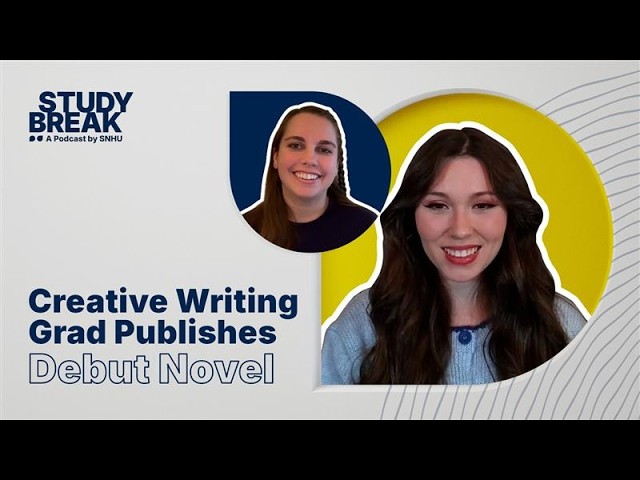
Jessica L. Cozzi '22MFA, an SNHU graduate with an MFA in Creative Writing, works full-time as a publicist. She said she loves what she does — but she has to get creative with her personal writing projects.
"I write on my lunch break, I write after work, I write on the subway, but it's not very consistent because my schedule looks different every day," she said.
But Sunday mornings? For the past five years, she has dedicated them to writing at a New York coffee shop.
"If my friends want to go to brunch, I'm like, sorry, it has to be after 12. I have an appointment from 10 to 12," she said. "I guard that time the way I would guard an appointment I made (with) a doctor."
It's not always easy to stick to the schedule, but Cozzi leans into her writing group for accountability.
"Every Sunday, pretty much, unless somebody's sick or it's a holiday, we all show up virtually," she said.
It's through this process that Cozzi wrote her debut novel, "We've Hit Turbulence," which was published earlier this year.
Read more: How to Write a Novel
Does Creative Writing Pay Well?
Unlike other professional fields — in areas like business, engineering, education, medicine and law, among others — that typically have a salary range based on experience and the level of your degree, there is a vast disparity in what creative writers earn.
While high-profile, bestselling authors can command six-figure advances for their work, they comprise just a small fraction of those earning a living as creative writers, Hart said.*
“Most of us are midlist writers, earning modest advances and royalty checks,” she said. “It's interesting to note that I can earn as much off of two 4,000-word researched essays for magazines as I can for one of my young adult novels.”
Hart said that it’s common for creative writers to generate their income from a combination of different forms of writing for a variety of outlets, along with other professional activities where they’re paid for their professional expertise. For example, Hart said she earns her living through a combination of:
- Fiction writing
- Nonfiction writing
- Private teaching and instruction through her website
- Teaching college-level creative writing
According to BLS, the median annual wage for writers and authors in 2024 was $72,270.* The top paid writers and authors work in information, educational services, and professional, scientific and technical services industries, BLS reported.*
“But creative writing isn't about the money, for me,” she said. “It's about getting to join the conversation and put something beautiful and inspiring out into the world.”
Discover more about SNHU's online bachelor’s in creative writing: Find out what courses you'll take, skills you'll learn and how to request information about the program.
*Cited job growth projections may not reflect local and/or short-term economic or job conditions and do not guarantee actual job growth. Actual salaries and/or earning potential may be the result of a combination of factors including, but not limited to: years of experience, industry of employment, geographic location, and worker skill.
Cary Jordan is an Iowa-based writer with more than 20 years of writing and editing experience on a wide range of issues related to higher education. Jordan has held administrative and cabinet-level positions at multiple colleges and universities, and his writing has spanned topics related to undergraduate education as well as graduate education in the areas of business, law, medicine and engineering, among others. Connect with him on LinkedIn.
Explore more content like this article

Why the Humanities Are Important Now More Than Ever

Academic Spotlight: Dr. Karen Wilkinson, Associate Dean of Online Communication Programs

Creative Writing MA vs. MFA: What's the Difference?
About Southern New Hampshire University

SNHU is a nonprofit, accredited university with a mission to make high-quality education more accessible and affordable for everyone.
Founded in 1932, and online since 1995, we’ve helped countless students reach their goals with flexible, career-focused programs. Our 300-acre campus in Manchester, NH is home to over 3,000 students, and we serve over 135,000 students online. Visit our about SNHU page to learn more about our mission, accreditations, leadership team, national recognitions and awards.