

What is a Degree in Math and Why is It Important?


Understanding the numbers
When reviewing job growth and salary information, it’s important to remember that actual numbers can vary due to many different factors—like years of experience in the role, industry of employment, geographic location, worker skill and economic conditions. Cited projections are based on Bureau of Labor Statistics data, not on SNHU graduate outcomes, and do not guarantee actual salary or job growth.
Mathematics is the study of quantity, structure, space and change. As abstract as that may seem, math is, at its core, a quest for absolutes, definitive solutions and answers. We may think of long numeric chains, seas of fractions or spreadsheets stacked with figures, but many don’t realize that math’s complex equations are roads to simplicity. As a result, believers in better, faster, more innovative solutions are often drawn to math.
We need math. Galileo Galilei used it to explain the universe. Math resolves truths and uncovers errors, making our work more credible. Reports, studies and research are all but discounted without quantifiable facts. Math equals proof. Math validates.
Is a Math Degree Useful in the Real World?
A math degree is useful in the real world because today, math is around you all the time. When you're at the department store, balancing your checkbook or doing your taxes, mathematics is a necessary skill. It can even improve your sports game.
Many who go to college to pursue a mathematics degree find out along the way that numbers are just a fraction of the allure. Math can teach us how to look longer and harder for solutions — a skill applicable to any career and life in general.

"Mathematics degrees are important and relevant today because of the direct and indirect application of mathematics to various fields of study," said Mark Gruen, an associate dean of global campus mathematics at Southern New Hampshire University (SNHU) who previously taught math and physics in Boston public schools at the high school level.
While learnings in this program can be applied across STEM (science, technology, engineering and mathematics) fields, the skills you may gain can also translate to other areas. "Math is all around us, from the data we see in the news to our own personal finance, and everywhere in between," said Gruen.
What Skills Do You Gain From Getting a Math Degree?
There are a host of skills you can gain from earning a degree in math. A bachelor's degree in mathematics fosters an appreciation for the role of mathematics in society, from early times through the technological age, for example. And, when you earn your Bachelor of Arts (BA) in Mathematics online, you may develop advanced mathematical methods, reasoning and problem-solving skills. Online math courses may also prepare you for careers that are versatile, command high salaries and have a high degree of job satisfaction.
Online math courses can give you a solid grasp of mathematics related to business, natural sciences and social sciences. Additionally, they can help you become proficient in communicating about math, both orally and in writing. Finally, you can learn how complex and real-world problems can be solved using mathematical concepts by adding an applied mathematics concentration.
Students enter online mathematics programs for many different reasons — professional success is just one of them. Many students also use the program to prepare themselves to continue their education in a graduate program.
The bachelor-level program is good preparation for graduate degrees such as:
- Master of Business Administration
- Master's in Finance
- Master's in Data Analytics
Read more about how to choose a graduate program.
Find Your Program
Is a Math Degree Worth it?
Getting an online degree in mathematics can open up a world of possibilities for you. And the U.S. Bureau of Labor Statistics (BLS) reports that in 2024, mathematicians and statisticians made a median salary of $104,350.*
Candidates with math degrees and a background in the field may have an advantage over those who don't. According to BLS, entry-level mathematician and statistician positions may be available to those with a bachelor's degree. What is a math-related degree at the graduate level? Added insurance. BLS said that a master's degree is typically required for a career in math or statistics.
Possessing a master's degree in math lets employers know that you have a solid grasp of mathematics, as well as related skills. Strong quantitative and data analysis skills and experiences in a related discipline — such as business, computer science or statistics — are a positive addition to your resume.

After a 10-year break from school to raise her four children, Emma Hutchison ’23 returned to finish her degree. To her surprise, she said, she ended up fast-tracking her way through SNHU’s math program with a concentration in applied mathematics, finishing much faster than she anticipated with the help of transfer credits through Sophia Learning.
“I was nervous to start again after all that time away from school,” she said. “(But) I learned that hard work and determination can produce great results.”
Hutchison said she’d always had an affinity for math and enjoyed reconnecting with the part of herself that loves to learn and succeed academically. She sees her degree as a way to create more stability and opportunity.
“This degree will change the life of my family,” she said. “As my husband and I switch roles, him being the stay-at-home dad and me being the working mom, this degree will hopefully allow us to live more comfortably as we continue to raise our children.”
What Can I Do With a Degree in Math?
One of the most exciting benefits of getting a math degree is the broad career options that are available, according to Gruen.
He noted a few roles that mathematics majors might consider include:
- Data analyst or scientist
- Economist
- Financial analyst
- Operations research analyst
- Statistician
Many other professions require math proficiency too, such as engineering, medicine, physics, nursing, computer science and actuarial science. In addition, virtually all fields benefit from the analytical and problem-solving skills students learn in mathematics. Therefore, anyone entering a STEM career is expected to have harnessed basic and advanced math concepts.
Even chef or gardener professionals use math fundamentals when measuring and purchasing supplies. If you're an event planner, math will help you figure per-head costs and inventory. Tailors and decorators use math daily, as does anyone who works with measurements and schedules.
According to Gruen, the skills learned in a mathematics degree are highly transferable to other fields that may be less focused on math. Some of these skills include:
- Creativity
- Critical thinking
- Logic
- Persistence
- Time management
Learn more about what you can do with a math degree.

Are Math Majors in Demand?
The short answer is yes. BLS reports an 8% projected growth rate for mathematicians and statisticians by 2034, which is more than twice as fast as the average projected growth rate for all occupations.*
Today's tech-filled world depends on people who understand math, which makes math majors in demand. Take data analysis, for instance: "As industries rely more and more on data, the need for individuals with the skills that a mathematics major has developed also grows," said Gruen. "Additionally, technologies such as artificial intelligence (AI) are built on mathematical principles, where the mathematics major has insight into how the technology functions and makes decisions."
According to Statista, the amount of data created, captured, copied and consumed globally is projected to increase rapidly by 2029. That means more businesses will seek mathematicians to analyze the large volumes of information collected.* This data will help companies grow, improve and develop new products and processes. Data analytics is also used to help businesses advertise to the right potential customers.
Mathematicians will also be needed to help information security analysts create data-security systems to protect the confidentiality and personal information of everyone with internet access.
Gruen recommended choosing electives related to the careers that interest you and suggested courses like data analytics and programming. "While data analysis and programming are part of a well-rounded mathematics curriculum, having additional skills in these areas is essential for most technical careers," he said.
You Don’t Have to be a Mathlete
Many people believe math talent is a born trait or inherited. Not so, researchers said. Natural math ability only gets you so far. Hard work and good study habits are far more valuable.
And there are many strategies to study math that can aid your educational journey. You don't need to be a math-minded genius when you enter college. Students entering college math degree programs aren’t math-minded geniuses.
"Learning mathematics (and learning more generally) is not about filling our brains with information but is experiential and learned through practice," said Gruen. "Exploring mathematics and engaging in the problem-solving process is what yields the important skills that come from earning a mathematics degree."
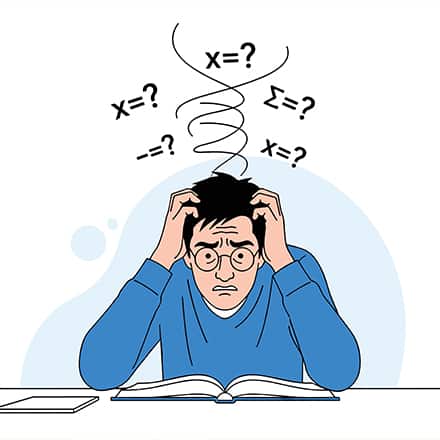
According to an Oxford Learning article, many children experience math anxiety, and the piece explores the reasoning behind that and offers potential solutions.
The report makes a case that math anxiety can begin as early as first grade, disrupting the working memory students rely on to keep track of numbers by overwhelming it with stress. When that happens, students can fall as much as half a year behind in math.
According to the article, math anxiety can stem from pressures such as timed tests or the fear of embarrassment. However, Oxford Learning suggests several strategies to combat it, including reframing tests and assignments as challenges rather than threats, which will help keep students on track as the material becomes more complex over time.
Read more about 9 study habits to boost learning.
Do Chromosomes Have Anything to Do With It?
Are boys better at math than girls? Recent research published in the journal Nature shows no difference in math performance at the start of school, but a gender gap appears in first grade, suggesting the difference develops due to environmental factors rather than genetics.
Additional research from the Association for Psychological Science helps explain how social beliefs contribute to the gender gap. The study found that in classrooms where more students believed boys were naturally better at math, girls’ math scores were lower and boys’ scores were higher, even though girls generally performed better overall. In those settings, girls were also less likely to enroll in extra math courses and more likely to report stress, difficulty and lower perceived relevance of math to their future.
If you think math isn’t your thing or have math anxiety but love finding solutions, it’s time to re-examine a math degree. Research proves that drive and desire, not natural ability, are the most critical factors for success.
Discover more about SNHU's bachelor's in mathematics: Find out what courses you'll take, skills you'll learn and how to request information about the program.
*Cited job growth projections may not reflect local and/or short-term economic or job conditions and do not guarantee actual job growth. Actual salaries and/or earning potential may be the result of a combination of factors including, but not limited to: years of experience, industry of employment, geographic location, and worker skill.
Rebecca LeBoeuf Blanchette '18 '22G is a writer at Southern New Hampshire University, where she fulfills her love of learning daily through conversations with professionals across a range of fields. She earned her Bachelor of Arts in Communication with a minor in Professional Writing at SNHU’s campus in Manchester, New Hampshire, and followed her love of storytelling into the online Master of Arts in English and Creative Writing at SNHU. Connect with her on LinkedIn.
Explore more content like this article

Academic Spotlight: Max Callahan, Associate Dean of Game Programs

How Internships Helped Justin Charles Get Ready for Takeoff
What is Math Anxiety and How Can You Manage It?
About Southern New Hampshire University

SNHU is a nonprofit, accredited university with a mission to make high-quality education more accessible and affordable for everyone.
Founded in 1932, and online since 1995, we’ve helped countless students reach their goals with flexible, career-focused programs. Our 300-acre campus in Manchester, NH is home to over 3,000 students, and we serve over 135,000 students online. Visit our about SNHU page to learn more about our mission, accreditations, leadership team, national recognitions and awards.