

The 9 Best Reasons for Getting an MBA Degree


Understanding the numbers
When reviewing job growth and salary information, it’s important to remember that actual numbers can vary due to many different factors—like years of experience in the role, industry of employment, geographic location, worker skill and economic conditions. Cited projections are based on Bureau of Labor Statistics data, not on SNHU graduate outcomes, and do not guarantee actual salary or job growth.
You know you want to take your career to the next level, and you're ready to get down to business with a master's degree. Perhaps you've heard that an MBA can be the best way to go. But what exactly is an MBA, and how do you know it's the right choice for you?
An MBA stands for Master of Business Administration. It’s a master’s degree geared toward current and aspiring business professionals. Earning this credential signals to employers and colleagues that you have gained educational expertise in the various facets of business administration.
Once you understand what an MBA degree is, you'll want to know how earning one can help you and your career.
Why Get an MBA Degree
Your decision to apply for MBA degree programs can be personal and unique — just like the journey to earning one.
Here are nine reasons why getting an MBA might make sense for you.
 Boost Your Salary Potential
Earning an MBA is an investment, but research indicates it can also increase your financial gain right away.* The median starting salary for MBA graduates was estimated to be $125,000 in 2025, according to the Graduate Management Admission Council (GMAC) Corporate Recruiters Survey (GMAC 2025 PDF source).*
That's 67% more than employees with a bachelor’s-level education, who, GMAC estimated, earned a median salary of $75,000 in 2025.* This means that MBA graduates are positioned early to out-earn their colleagues with only a bachelor's degree.
 Increase Opportunities for Employment and Advancement
An MBA can help you bolster your identity in the workforce, whether you're just starting out or are looking for a career change. In 2025, 90% of surveyed employers planned to hire MBA talent, GMAC's survey reported.*

Those three letters — MBA — can add weight to your resume, professional profile and email signature. They signal to employers that you have advanced business knowledge.
Justin Reedy ’21MBA hopes to one day own his own consulting company or achieve an executive position. He said he believes his advanced business education at Southern New Hampshire University (SNHU) will help him get there. “The MBA is a foundational piece of achieving these dreams,” he said.
The 2024 GMAC Corporate Recruiters Survey reinforces this sentiment. Since 2022, most employers have indicated to GMAC that they believe graduates with a master's in business are often fast-tracked to upper-level positions (GMAC 2024 PDF source).*
 Obtain Holistic Business Knowledge and Skills
Whether you opt to add a concentration or not, MBAs can be applied to all facets of a business and help you gain the knowledge and skills needed to grow as a professional.
Recruiters report high levels of confidence when it comes to the skills of business school graduates, according to the 2025 Corporate Recruiters Survey, especially relating to:
- Communication: 66%
- Versatility of skill set: 61%
- Strategic thinking: 59%
While the MBA curriculum can vary by institution, many offer core classes that help you explore how different aspects of business come together.

"Core classes typically cover areas such as finance, marketing, strategy and innovation, while also integrating topics like brand optimization, performance measurement and organizational leadership," said Dr. Robert Shindell, a graduate business instructor at SNHU with a range of experiences in workforce development, instructional design, consulting and more.
SNHU alumnus Reedy decided to earn an MBA so he could become a well-rounded business professional. He said the general MBA track helped him gain greater fluency in accounting, finance and business writing. “I would recommend the MBA to anyone that works in business and wants to comprehensively understand their business better,” he said.
The best MBA programs give you the space to practice solving genuine business problems. Using teaching methods such as scenario-based learning, you can gain relevant experiences that supplement the theories you learn and help you overcome challenges.
This approach can help you develop your analytical, problem-solving and decision-making skills, according to Shindell.
"Through case studies, collaboration and applied projects, you gain practical skills in solving complex problems and making informed decisions in real-world situations," he said. All of which, he noted, can help prepare you for leadership and strategic roles.
Read more: What Can You Do With an MBA?
 Specialize Your Skill Set
If there's an area of business that interests you most, you can find an MBA degree that offers concentrations or specializations that let you focus on that particular subject.
Consider an MBA with a concentration in Healthcare Management, for instance. In addition to the core courses you'll take, you may have the opportunity to navigate the ever-changing healthcare landscape and gain the knowledge and skills necessary to push your organization and career forward.

Faizan Malik ’21MBA decided to earn a master’s degree that complemented his role in health information technology — so he chose an MBA with a healthcare concentration at SNHU.
“The decision to pursue an MBA in this area was simple at that point,” he said. “I could advance in my career while learning about topics that I was actually interested in.”
Malik said he has used what he learned in his program to make improvements within his team and seek out new opportunities.
 Gain New Perspectives
With a greater understanding of how businesses work comes new perspectives — even if you've already logged years of experience in the workplace.

Although Malik worked in health information technology before earning an MBA, he said some of his courses gave him different points of view to consider and introduced him to other processes happening within his workplace.
Not only can the information in MBA courses introduce you to new concepts and perspectives, but the people you're learning alongside can too.
In addition to an emphasis on growing technical skills in areas such as artificial intelligence (AI) and data analysis, employers participating in the 2025 Corporate Recruiters Survey noted the continued need for human skills. Specifically:
- Communication skills
- Cross-cultural competence
- Emotional intelligence and coachability
- Interpersonal/teamwork skills
- Networking/relationship building
Throughout your program, you may have the chance to work with peers and instructors from diverse backgrounds, adding depth and a range of experiences to class discussions.
 Grow Your Professional Network
As soon as you enroll in a degree program, you’ll enter a community of peers, faculty, staff and alumni.
"Even in an online environment, you can connect with peers who share similar career goals and interests," Shindell said.
If you attend a university with an expansive alumni association, he also noted that you can gain access to professionals in different industries. Building relationships with them can help you explore careers and learn through their experiences, he said.
And with faculty who double as industry professionals, you can tap into a large group of people who can help you grow in many ways.

"Ultimately, networking in an MBA program is about intentionally building one-on-one connections that expand your perspective, strengthen your professional presence and create lasting opportunities beyond the classroom," Shindell said.
The 2026 Prospective Students Survey by GMAC reported that 63% of graduate business school candidates noted networking as one of the most important skills to learn in grad school (GMAC 2026 PDF Source).
Professional networking is valuable throughout your career. Even when you graduate, you’ll remain part of your alma mater’s community.
 Spend Less Time and Money Than You Might Think
When considering the logistics of getting an MBA, how much time and tuition it will take are likely some of your deciding factors.
If you’re wondering how long it takes to get an MBA, there are many variables — including the school you choose, prior learning credits and preferred pacing.

For example, an online MBA from SNHU is 30 credits in length for those with an undergraduate degree in business. It can take just over one year to complete if you’re taking two courses per term.
While college is an investment, it doesn’t need to break the bank. Tuition for some programs, like SNHU’s, costs less than $20,000. Military status can reduce that further, and you may be able to take advantage of tuition reimbursement programs through your employer.
Many graduate students are also eligible for financial aid and scholarships, so filling out the Free Application for Federal Student Aid — FAFSA — is important.
 Bypass Common Barriers to Graduate Education
Arranging and preparing for standardized testing takes time — and can be an additional cost in your pursuit of a master’s degree. The good news is that some graduate schools do not require scores from traditional tests such as the Graduate Record Examination (GRE).
So, applying to MBA programs with no scores required means you might begin your degree sooner. You will, however, need to provide a transcript from your undergraduate education. Staff at some schools will help you with this step.
There are many types of MBA programs these days. Whether you want to attend your classes in person or at a pre-determined time each week — or would prefer the flexibility that online programs offer — there’s sure to be an MBA out there that meets your needs.
Consider term lengths and course loads, too. For example, SNHU offers five 10-week online graduate terms each year, and you can choose to take one or two classes per term.
Read more: Is an Online MBA Worth It?
 Achieve Personal Fulfillment
While it’s true an MBA degree can benefit your professional life, some people choose to pursue their degree for very personal reasons.
In addition to wanting an advanced degree that matched his field, Malik decided to earn an MBA because it was important to his family — especially his father. “They always wanted me to continue my education, and I can’t thank them enough for pushing me as well,” he said.

According to the 2026 Prospective Students Survey, the number one reason why students want to pursue a graduate business degree is to enrich their lives and develop their potential. It takes persistence and dedication, and receiving your diploma is a tremendous achievement many graduates and their families celebrate.
“In my personal life, just the overwhelming feeling of being proud of my accomplishment — from myself and my family — has been more than enough,” Malik said.
Find Your Program
What Inspired You to Pursue an MBA?

For Cheri Federico '25MBA, it was the prospect of career advancement.
When the business she worked at experienced a reorganization, an opportunity arose, accompanied by the question: How quickly can you finish that master's program?
As it turned out, Federico was in the final class of her MBA at SNHU — a timely achievement that helped her move into that new role. (Note: Career advancement isn't a guarantee for all SNHU graduates.)
Her change management courses, in particular, ended up being beneficial as her organization navigated a big shift.
"My last two classes were all about change management: how to change, how to handle change with your teams and all of that," Federico said. "I was able to directly use that right at the time ... that I was going through all of that at work."
Now with an MBA under her belt, Federico said she's become a more thoughtful, goal-oriented leader.
"(I) take a breath and think about what I'm going to say before I say it, where I used to be right off the cuff," she said. "I've taken a lot of those tools that I've learned, and I'm able to apply those tools now and kind of take a team ... in a positive direction."
Federico highlighted that a master's degree is something no one can take away from you.
So: "Keep doing it," she said. "Show up every day. It's worth it."
Types of MBA Concentrations
There are numerous angles and aspects of a business — some you may enjoy and find more relevant than others. That’s why you can choose to focus on one of many types of MBA concentrations.
Some of your concentration options include:
- Accounting
- Entrepreneurship
- Human Resources
- Marketing
- Project Management
If you prefer, you could follow a general MBA track instead and use your business electives to explore multiple areas of interest.
"Whether you choose to specialize or remain a generalist, an MBA equips you with the tools to lead teams, navigate uncertainty and create meaningful value in a wide range of professional settings," Shindell said.
No matter what type of MBA you pursue, you'll want to be sure it's earned accreditation. For example, SNHU's program is accredited by the Accreditation Council for Business Schools and Programs (ACBSP).

MBA Program Requirements
A bachelor’s-level education is the general prerequisite to the MBA application. From there, every institution has its own application and admission process.

For example, some may require specific test scores or essays, while others may schedule formal interviews or request letters of recommendation. Once you decide where you want to apply, be sure to speak with an admission counselor about any requirements you may need.
The MBA curriculum varies by school and program, too, but you can generally expect to take core classes.
SNHU’s MBA, for example, requires seven core courses that weave together different areas of business for a holistic point of view on overarching matters of a business. In addition, there may be a handful of business electives you can allocate to a specific concentration or choose to cherry-pick among a range of classes.
Toward the end of your program, you may also need to complete a capstone.
So, is It Worth It to Get an MBA?
If you’re looking to grow as a business professional and you find a program and institution that feels right for you, earning an MBA may be worth it. Adding MBA to your title can be personally rewarding and make you a more competitive employee.
“If you want to advance in your career, or even just do it for yourself, I will say an MBA is more than worth it,” Malik said. “Going back to school will likely be the hardest part for most people, but once you see that degree in the mail and all the doors it unlocks for you, you will only be remiss you didn’t do it sooner.”
MBA programs can help you upskill, supporting your development of skills that transfer to the workplace.
“For someone who is looking to get into management, my MBA courses definitely gave me new skills and knowledge base,” Malik said. “From a refresher on basic finance and accounting skills to learning how various business laws and compliance policies work to (an) in-depth understanding of IT infrastructure and current healthcare informatics trends, the skills learned throughout the program are really invaluable.”
Explore academic catalogs to get a sense of the courses you might take as well as the learning outcomes, and see how they align with your interests. You could also speak with your employer, mentor or admission counselor at a university that interests you to see if the degree is the right fit for your goals.
Should you decide to pursue an MBA, Shindell recommends doing so with curiosity, discipline and a growth mindset. "The more you challenge yourself, apply what you’re learning and stay intentional about your goals, the more meaningful the experience will be," he said.
Discover more about SNHU’s online MBA programs: Find out what courses you'll take, skills you’ll learn and how to request information about the program.
*Cited job growth projections may not reflect local and/or short-term economic or job conditions and do not guarantee actual job growth. Actual salaries and/or earning potential may be the result of a combination of factors including, but not limited to: years of experience, industry of employment, geographic location, and worker skill.
Rebecca LeBoeuf Blanchette '18 '22G is a writer at Southern New Hampshire University, where she fulfills her love of learning daily through conversations with professionals across a range of fields. She earned her Bachelor of Arts in Communication with a minor in Professional Writing at SNHU’s campus in Manchester, New Hampshire, and followed her love of storytelling into the online Master of Arts in English and Creative Writing at SNHU. Connect with her on LinkedIn.
Explore more content like this article

How Jordan Earned 2 Degrees in 2 Ways at the Same University
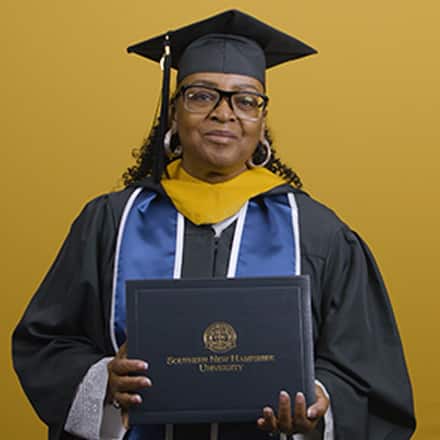
Cynthia Preston ’26 Tailored Her Way to a Marketing Degree

How Do You Become a Financial Advisor?
About Southern New Hampshire University

SNHU is a nonprofit, accredited university with a mission to make high-quality education more accessible and affordable for everyone.
Founded in 1932, and online since 1995, we’ve helped countless students reach their goals with flexible, career-focused programs. Our 300-acre campus in Manchester, NH is home to over 3,000 students, and we serve over 135,000 students online. Visit our about SNHU page to learn more about our mission, accreditations, leadership team, national recognitions and awards.